

Under construction Last Updated 8.17.26. Please feel free to share this page with a link back and credit.
Overview
Modern life is full of stress, misinformation, fractured communities, and ecological limits. In that environment, personal principles and values aren’t just “nice.” They guide and create outcomes that are either sustainable or destructive.
The new Universe Principles of Right Action (what to do) and Right Attitude (how to do it) are a practical set of reality-aligned, science-informed guiding actions and attitudes designed to help individuals and groups succeed and thrive in the often harsh and rapidly changing realities of the 21st century. If you practice its principles, it will help you align your life's actions with the universe's most powerful and time-proven evolutionary patterns and experience what has been called the beautiul "flow state or "in the zone" state more frequently in your daily life.
No matter where you are right now, wouldn't it be nice to update and upgrade your success tools?
These behavioral and attitudinal success guidelines support enhanced, robust decision-making amid the many uncertainties of the 21st century. If you are creating a new organization or community in today's environment, these are the success guidelines you would want your team to adopt.
“They significantly improve odds; they don’t guarantee outcomes.”
“They don’t make anyone superior. They’re tools, and tools can be used badly.”
By the way, when we say ‘Right,’ it does not mean morally superior. It means reality-aligned and evidence-informed.
Please note, at any time you can jump to these key page sections:
Short Form Right Actions | Short Form Right Attitudes | 7-Day Experiment | Long Form Right Actions | Long Form Right Attitudes | Glossary | References
Introduction
The simplest way to describe these right actions and right attitudes is that, together, they provide the essential guidelines that any individual or group needs to achieve sustainable, long-term, and meaningful success. These new tools can genuinely boost your success, happiness, and sense of meaning, which is refreshingly un-mystical.
If you’re curious about the “how” and “why” they work, we’ve also included the long-form, deeper learning version of the Right Actions and Attitudes to help you go a bit deeper and learn more about why and how they work after you read the short-form Right Actions and Attitudes. At the bottom of the page, we have included additional reference materials. But you don’t need to read the whole library before you start using them. This isn’t a graduate seminar. It’s your life. If you begin practicing these principles and notice real improvements, you can save the deeper science explanations for later.
The best way to understand the power of these principles is the old-school way: direct personal experience. And they even have some surprise positive cumulative effects.
One last thing: we believe it will take new thinking, principles, values, and tools to resolve the unique problems of the 21st century. What you will find on this page and on this website will help move you in that direction.
The Short Form Right Actions: Designed for Managing the Challenges of the 21st Century
Before you start reading the actions below, we need to briefly discuss how the Right Actions and the Right Attitudes are organized into four important ways, or quadrants, for seeing change in reality. For now, here are quick definitions for the four quadrants. (More will be said about them at the bottom of the page.)
Process: What’s changing over time: the steps, phases, growth/decline, momentum, and timing.
Relationship: What’s connected to what: who/what affects who/what, feedback loops, dependencies, and influences.
Context: The setting and the big picture: what situation we’re in, what surrounds the thing, what conditions shape it.
Transformation: When those changes and connections reshape the whole situation, it becomes a different kind of system (not just “more of the same,” but a new pattern).
That’s the whole trick: C tells you where you are, P tells you how it moves, R tells you what’s connected, and T tells you what it’s turning into.
Now grab a piece of paper and a pen. After you read each Right Action, give yourself a rating from 1 to 10 to rate how well you're actually living and doing that particular guiding action.
For most people, even if they are doing well in life, reading and rating themselves is, of itself, a huge eye-opener, revealing blind spots they were not aware of. Besides rating yourself, you can also rate any group, corporation, or nation. You may be stunned to discover how many of these essential Right Actions and Right Attitudes your group, corporation, or nation is missing or doing the exact opposite of.
Those who become proficient with this collection of principles and guidelines also sometimes experience what highly successful individuals and athletes call "the flow state." This is where things are "naturally" working right, flowing, and easier than expected. But this flow state is also a bit different from that of an athlete or a successful businessman; it can be more sustainable and meaningful.

Right Action Process
What Process Is: emergence/development/becoming.
What Process Does: keeps thinking fluid by tracking unceasing motion and how things change over time.
-
- Run small experiments: Try small new things regularly so you keep improving instead of getting stuck.
- Observe clearly (including what’s missing): Pay attention to yourself, others, your environment, and what isn’t being seen.
- Use fast feedback: Do, measure, learn, and adjust quickly so you improve faster.
- Practice evidence hygiene: Separate facts from guesses and track what would prove you wrong.
- Defend your information: Verify before you share or believe, because misinformation spreads fast.
- Protect your attention: Set boundaries on screens and feeds so your mind stays yours.
- Build transferable skills: Keep learning skills that help in many situations as the world changes.
- Be reliable: Build discipline and health habits so people (including future-you) can count on you.
Right Action Relationships
What Relationship Is: common ground/intrinsic connection (including constitutive links).
What Relationship Does: shows how things “different” or opposed still share what holds them together, so you can reason about interdependence.
-
- Practice kindness and service daily: Do small acts of help regularly, so cooperation stays human.
- Keep exchange fair: Maintain balanced give-and-take so relationships and systems don’t rot.
- Share benefits with cooperators: Make teamwork worth it by ensuring contributors actually benefit.
- Stop free-riding and gaming: Use clear rules and consequences to prevent cheaters and "system gamers" from ruining the group.
- Repair quickly: If you cause harm, own it, apologize, and make amends.
- Improve group functioning: Build teams where people can speak up and solve problems without drama.
- Build conflict skill (use tension for development): Listen, de-escalate, negotiate, and turn conflict into higher integration.
Right Action Context
What Context Is: the “big picture” of organized, patterned wholes (structure that can remain stable across change).
What Context Does: locates parts within a larger whole and clarifies structure, layers, and boundary conditions.
-
- Create value sustainably: Contribute in ways that don’t wreck your health, relationships, or environment.
- Stay within ecological limits: Use resources in ways nature can recover from.
- Protect the commons: Design safeguards for shared resources like trust, public goods, and the environment.
- Increase accountability: Make actions and results visible enough that good is rewarded and harm is corrected.
Right Action Transformation
What Transformation Is: a system-in-transformation that presupposes and synthesizes Process, Context, and Relationship.
What Transformation Does: reveals limits of stability and how systems reorganize into new forms while maintaining themselves in changed form.
-
- Build resilience reserves: Keep buffers (time, money, supplies, support) so shocks don’t wreck you.
- Simplify adaptively: Cut useless complexity so energy goes to real problems.
- Red team it before you release it: Stress-test what you publish or deploy to catch errors, blind spots, and unintended harm.
- Participate in the civic commons: Show up, vote, serve, and watchdog institutions so they don’t get captured.
- Scale what works ethically: Spread proven practices in ways that help people and don’t create new damage.
The Short Form Right Attitudes: Designed for Managing the Challenges of the 21st Century
Right attitudes are simply guiding and foundational mindsets. Using the same paper that you rated your right actions, rate 1-10 how well you're actually currently living that particular Right Attitude.

Right Attitudes Process
-
- Humility + update-fast: Assume you might be wrong and change your mind when better evidence shows up.
- Acceptance without surrender: See reality's "issness" clearly without denial, then act on what you can change.
- Change is normal: Expect change and get skilled at adapting instead of clinging to yesterday.
- Think in probabilities (watch tipping points): Use scenarios and backups because the future is messy and can shift suddenly.
Right Attitudes Relationships
-
- Constraint-based compassion: Care about people while respecting limits like time, energy, money, and ecosystems.
- Dignity-first compassion with boundaries: Treat people with respect while still setting firm limits on harmful behavior.
- Cooperation needs maintenance (some ties are constitutive): Keep cooperation fair and protected, because it doesn’t survive on good intentions alone.
- Integrity builds coordination: Be honest and consistent because trust is what makes groups work.
- Repair is strength: When trust breaks, repair it quickly, because resentment is a slow poison.
- Stewardship posture: Take responsibility for your part without pretending you’re the hero of the universe.
Right Attitudes Context
-
- Reality-first: Treat the real world as the final judge, because reality always collects the bill.
- Evidence over vibes: Believe things based on strong proof, not because they feel true or match your tribe.
- Systems thinking (include what’s missing): Look for feedback loops, side effects, delays, and what’s missing or hidden.
- Both-and thinking: When possible, combine good ideas instead of forcing fake either/or choices.
- Anti-capture realism (not paranoia): Expect power and incentives to distort systems, so verify and design safeguards.
- Planetary-limits realism: Act like Earth has limits, because it does.
Right Attitudes Transformation
- Meaning, awe, gratitude (no denial): Stay inspired and appreciative while keeping your eyes open.

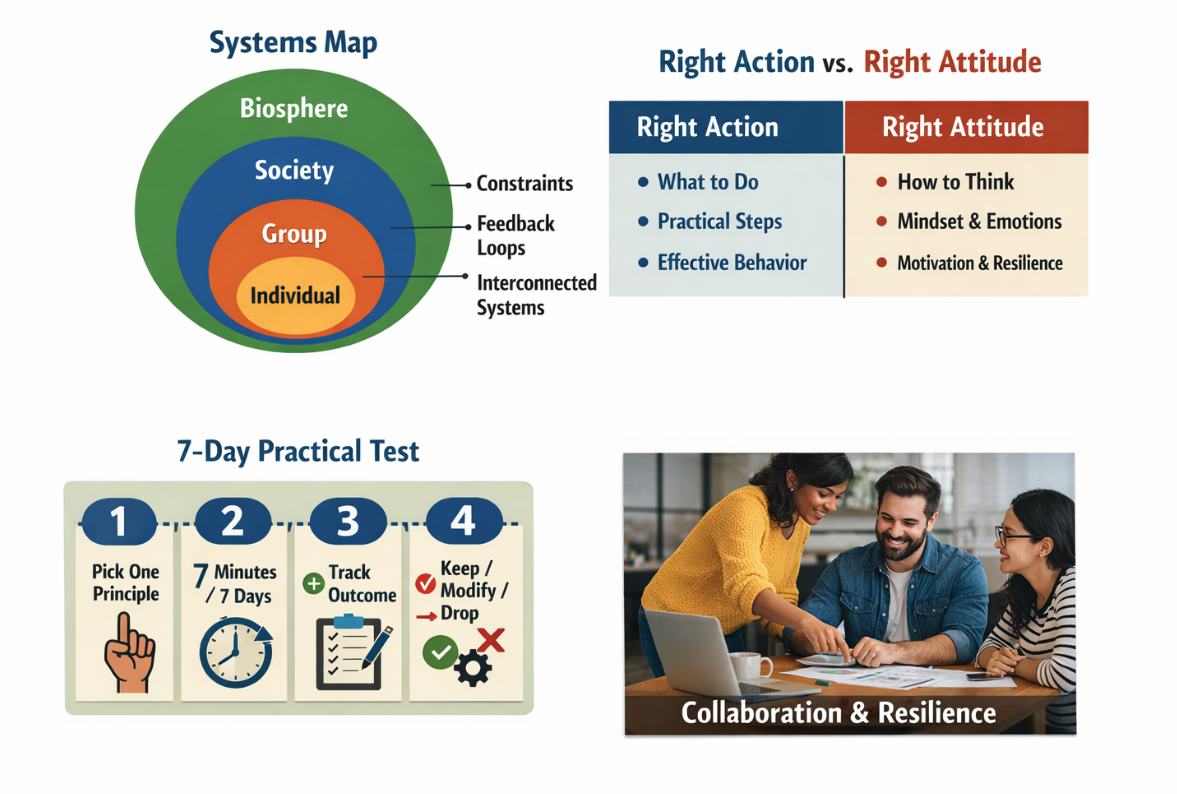
How to Start Your 7-Day Success Enhancement Experiment
There are two ways to start your seven-day experiment:
1. Jump right in after you read the short form actions and attitudes.
2. Go a bit further down this page and read the long-form actions and attitudes before you start the experiment. They contain much more information that will deepen your understanding of why they are so useful and effective. (If you "get" them already, don't worry if you leave the long-form actions and attitudes for after you have started the seven-day experiment.) The long-form actions and attitudes include the following additional sections to help you more deeply understand how they work.
Each long-form Right Action found below the short-form Right Actions includes four helpful “anchors”:
A Scientific Evidence section,
A Progressive Evolution principle connection,
A Human Virtue section, and
A Short Note to help you remember the principle and keep it human, usable, and not just “inspiring text you admire once and then ignore.”
Here’s the 7-Day experiment to prove the usefulness of these principles to yourself.
Step 0) Pick 3 quick metrics (so this isn’t just vibes)
Before Day 1, pick 3 metrics you can track in 30 seconds:
Choose 3:
• Stress (0–10)
• Sleep quality (0–10)
• Mood (0–10)
• Focus/productivity (0–10)
• “Spiky moments” (conflicts, blowups, passive-aggressive weirdness) — count
• Acts of kindness/service — count
Write your Day 1 numbers down. Congratulations, you now have your second baseline. (Your first baseline is the 1-10 ratings you assigned to yourself the first time you read these principles and guidelines.)
Optional but powerful: ask ONE trusted person to rate you on Day 1 and Day 7:
• “How present/calm did I seem?” (0–10)
• “How fair/kind was I in conflict?” (0–10)
Yes, this is mildly terrifying. That’s why it works.
Step 1) Print the short forms.
Print only the two short forms of the Universe Principles (Right Actions + Right Attitudes) found above.
Step 2) Do the 2-minute “where am I now?” ratings
For each principle, ask:
“How well am I currently applying this principle in my life?”
Rate 0–10:
10 = solid, consistent, real
0 = not happening
Write your Day 1 rating on the first blank line after each principle. (Second blank line = Day 7 rating.)
If you don’t understand or believe a principle yet, give yourself a 0.
This is a measurement, not a moral court case.
Step 3) Read daily for 7 days (or 7 total repetitions)
Each day, read the short forms. It takes about 7 minutes or less.
If you meditate, use these as your daily “reset.”
Miss a day? Keep going until you hit 7 repetitions. No perfection Olympics.
Step 4) Make it a real trial (simple, on purpose, daily)
This is the part where change happens. Keep it small and doable:
A) Pick ONE “Principle of the Day”
Choose one Right Action or one Right Attitude to focus on today.
B) Choose ONE tiny behavior
Ask: “What is one small thing I will do today that matches this principle?”
Small wins repeated beat heroic intentions abandoned.
C) Do a 2-minute end-of-day review
1) How did I do with my Principle of the Day? (0–10)
2) What result did I notice (good or bad)?
3) What was I missing or not seeing?
4) What’s my one adjustment for tomorrow?
Use these two questions anytime you feel stuck:
a) What am I doing that most violates this principle?
b) What simple thing could I do today to improve that?
Also: Self-acknowledge any real progress. That’s not fluff. That’s how humans reinforce behavior change without needing a marching band.
Your Daily 60-second “Mind Mechanism Check”:
-
- What did I feel threatened by today (status, belonging, control, certainty)?
- What story did my brain tell?
- Which principle would I apply if I weren’t defending my ego like it’s a national border?
Step 5) Day 7: Evaluate your results (no spiritual bypassing)
A) Re-rate every principle (0–10)
Use the second blank line after each principle.
B) Re-rate your 3 metrics
Compare Day 1 vs Day 7:
What improved? What didn’t? What got worse?
(Yes, worse is allowed. It’s called data.)
C) Circle your Top 3 “high-impact” principles
Which 3 helped most (or revealed the biggest problems)?
Those become your “starter set” for the next phase.
What to do next if you see meaningful benefits
Continue for 21 more days to deepen the habit. And here is a science reality-check: habits often take longer than 21 days to become automatic. Many people average around ~66 days, with wide variation. So 21 days is a great next sprint, but don’t quit early if you’re not “done.” By the way, the Universe Principles of Right Action and Right Attitude are part of a new philosophy called, the Way of the Universe.
If your 7 Day experiment was not successful:
Sometimes these powerful guidelines won’t work. As powerful as these principles are, it is also good to know that they don't always work because the challenging nature of the human mind can slow or blunt their effectiveness. Here are some of those challenges:
Your brain prioritizes survival over truth. Under threat, you’ll defend identity and belonging even when it harms outcomes.
Beliefs are embodied conclusions. Many were learned through pain, reward, conformity, or trauma. Logic doesn’t erase them.
We’re tribal by default. We cooperate within our group and compete with outsiders unless we build stronger systems.
Incentives beat intentions. If systems in your environment reward bad behavior, willpower will be lost unless you redesign those systems. (Most of the principles below are system optimization, redesign-related.)
Change comes from practice, not applause. Repetition + feedback + repair is what rewires humans.
There are also other reasons the Universe Principles are not effective until some earlier groundwork is stabilized. If someone is suffering from poverty, oppression, disability, or trauma, the principles can sound too simplistic and insensitive, like “apply these principles, and you’ll thrive.” Structural constraints also matter. These principles help, but they’re not a substitute for also engaging in justice, policy, and material support for those suffering from poverty, oppression, disability, or trauma.
The Universe Principles are an effective behavioral approach to improving the lives of individuals and groups. They are not a therapeutic approach. Sometimes an individual needs to first involve themselves in a therapeutic approach to make it easier for them to adopt a later behavioral approach to the issues that are most troubling or delaying them.
Here are the Long Form, Deeper Learning Right Actions for Creating Thriving, Sustainable Individuals and Groups of any Size
“Right relationship to the reality of what actually is… is what ultimately matters.” — Michael Dowd
The following guiding principles concern developing the right relationship with reality and aligning with the core patterns observed in evolution and cooperation research that has shaped progressive evolution across the universe. In plain terms, they help you work with how life actually functions, instead of repeatedly headbutting the laws of consequences and hoping they blink first.
There are several practical ways to use these principles:
Use them as a quick self-check or situation test. See how many you’re applying right now. (In general, the more you apply them to a situation, the more sustainable and successful your results tend to be.)
Read them daily as a brief meditation or reset. Think of them as a fast, grounding reminder that supports clearer thinking, better decisions, and more effective action.
And one more thing, because reality loves repetition: you have to practice these daily to really feel how quickly and powerfully they can improve your life. Reading them once is nice. Practicing them is where the magic is. Not the fake kind, the results kind.
One last thing: the long-form Right Actions and Right Attitudes, with their helpful descriptions under each action or attitude, should illuminate how these principles and guidelines unite the best of head and heart, rationality, feeling, and intuition. We hope they will help you to see the world a bit differently.
More About these New Guidelines
The science-grounded, evidence-based guiding principles or guideposts of Right Action and Right Attitude for effective living and problem-solving in the 21st century. They were created in part to help us manage humanity's growing polycrisis, but mainly to help individuals and groups be more effective and cooperative.
These action and attitude guidelines are the main road, not a scenic detour. What’s especially beautiful (and frankly, unusually practical for something this big) is that these guidelines are also:
a) Rational and science-grounded (not wishful thinking in a fancy outfit)
b) Universal and timeless in their applicability
c) Including and transcending the best principles and values from earlier philosophies
d) Culturally, racially, and ethnically neutral
e) Non-gender-biased
f) Balancing and honoring both right- and left-brain strengths (reason and meaning can coexist, shocking as that sounds)
g) Non-denominational, while still naturally metaphysical in the sense of deep connection, purpose, and lived integrity.
In other words, you don’t have to change your identity, adopt someone else’s worldview, or memorize a sacred handbook in the original language. You just practice what works, keep what improves life, and let reality do the scoring.
If you’re secular, treat this as systems + cooperation guidelines. If you’re spiritual, treat this as a moral practice grounded in rationality and reality.
Knowing and practicing the Universe Principles of Right Action and Right Attitude are the core of the Way of the Universe philosophy and 60% of everything this philosophy contains and can do for you
The Long Form Right Actions for Successful Evolution
Process
1) Run small experiments continuously (5–10%)
Statement: Reserve a small portion of effort for trying new approaches so you don’t stagnate.
Scientific evidence
-
- Exploration is necessary for learning and avoiding “local traps” in behavior and organizations.
Support from Progressive Evolution Principles
-
- Variation + selection is the engine of adaptation; experimentation feeds the engine (major transitions framing).
Related Human Virtues and Values
Curiosity, courage, creativity, patience, humility.
Note: If you never experiment, you’re basically asking the past to solve the future.
2) Observe clearly (including what’s missing)
Statement: Build situational awareness before acting, including what isn’t being noticed.
Scientific evidence
-
- Attention and mindfulness practices can improve noticing and self-regulation in many people.
Support from Progressive Evolution Principles
-
- Better sensing/modeling improves adaptive action and coordination (Stewart’s intentional evolution framing).
Related Human Virtues and Values
Awareness, discernment, patience, humility, calm.
Note: “I didn’t see that coming” is usually a perception problem before it’s a fate problem.
3) Quickly use feedback to adapt
Statement: Act → measure → learn → adjust, with short cycle times.
Scientific evidence
-
- Audit-and-feedback improves performance when feedback is timely and actionable.
Support from Progressive Evolution Principles
-
- Selection-by-consequences is how improvements stick.
Related Human Virtues and Values
Responsibility, humility, perseverance, honesty, courage.
Note: Slow feedback is how people stay wrong for years and call it “tradition.”
4) Practice explicit evidence hygiene
Statement: Separate facts from interpretations; label uncertainty; track what would disconfirm you.
Scientific evidence
-
- Confirmation bias distorts evidence handling, especially when identity is involved.
- Accuracy prompts reduce misinformation sharing.
Support from Progressive Evolution Principles
-
- Reliable shared truth is required for scaled cooperation and coordination.
Related Human Virtues and Values
Truthfulness, integrity, humility, responsibility, fairness.
Note: Your brain is a biased intern. Give it a checklist.
5) Build information defense
Statement: Verify before believing or sharing; protect your information environment.
Scientific evidence
-
- Accuracy-focused nudges reduce false sharing; friction improves truth-attention.
Support from Progressive Evolution Principles
-
- Cooperation collapses when shared information is corrupted.
Related Human Virtues and Values
Responsibility, truthfulness, self-discipline, fairness, prudence.
Note: Outrage is a business model. Accuracy is self-defense.
6) Protect your attention as a life-support system
Statement: Set boundaries on screens/feeds and train focus like it matters.
Scientific evidence
-
- Excessive digital use correlates with attention and well-being harms; boundaries protect cognitive function.
Support from Progressive Evolution Principles
-
- Learning and coordination require attention; attention collapse reduces adaptiveness.
Related Human Virtues and Values
Self-discipline, prudence, wisdom, balance, calm.
Note: If you don’t choose your inputs, an algorithm will. It will not choose for your flourishing.
7) Continually expand transferable skills and learning capacity
Statement: Keep building skills that stay useful across changing conditions.
Scientific evidence
-
- Robust strategies and learning approaches outperform single-track plans under uncertainty.
Support from Progressive Evolution Principles
-
- Increasing capability and evolvability strengthens adaptation (Stewart).
Related Human Virtues and Values
Curiosity, perseverance, humility, competence, responsibility.
Note: Skills are future-proofing. Vibes are not.
8) Improve self-regulation and reliability
Statement: Build habits of discipline, health maintenance, and follow-through.
Scientific evidence
-
- Self-control and reliability predict long-run outcomes across multiple domains (health, success, safety).
Support from Progressive Evolution Principles
-
- Stable cooperation requires reliable agents and predictable behavior.
Related Human Virtues and Values
Self-discipline, responsibility, trustworthiness, perseverance, balance.
Note: Reliability is kindness with a calendar.
Relationships
9) Practice kindness and service daily
Statement: Do small acts of kindness and contribution regularly, especially under stress.
Scientific evidence
-
- Kindness and prosocial behavior are associated with improved well-being and social trust.
Support from Progressive Evolution Principles
-
- Prosocial norms strengthen cooperation and group stability, enabling larger cooperative scales.
Related Human Virtues and Values
Kindness, compassion, generosity, patience, benevolence.
Note: “Small” kindness is only small if you’ve never needed it.
10) Live, give, and demand fair exchange
Statement: Keep reciprocity balanced so cooperation stays stable.
Scientific evidence
-
- Reciprocity and reputation are core mechanisms stabilizing cooperation.
Support from Progressive Evolution Principles
-
- Stable benefit-sharing reduces within-group conflict and supports larger cooperative units.
Related Human Virtues and Values
Fairness, honesty, justice, responsibility, respect, goodwill.
Note: Resentment is the interest rate on unfair exchange.
11) Wisely cooperate and share benefits with cooperators
Statement: Make cooperation durable by ensuring contributors reliably benefit.
Scientific evidence
-
- Cooperation persists when benefits are shared and incentives stay aligned.
Support from Progressive Evolution Principles
-
- Major transitions scale cooperation by aligning incentives and suppressing sabotage.
Related Human Virtues and Values
Loyalty, fairness, generosity, gratitude, responsibility.
Note: If contributors get punished, your “community” becomes a ghost town.
12) Contain free-riding and gaming
Statement: Use clear norms, monitoring, and proportional consequences so exploiters don’t drain the system.
Scientific evidence
-
- Commons governance succeeds with monitoring and graduated sanctions (Ostrom).
Support from Progressive Evolution Principles
-
- Cheater suppression is central to stable cooperation and higher-order organization.
Related Human Virtues and Values
Justice, responsibility, courage, fairness, integrity.
Note: Free riders don’t just steal resources. They steal morale.
13) Repair quickly: acknowledge harm, apologize, make amends
Statement: When you mess up, own it fast and restore trust where possible.
Scientific evidence
-
- Apologies and concrete repair actions can restore trust when sincere and followed through.
Support from Progressive Evolution Principles
-
- Cooperation persists when conflicts are resolved and relationships repaired instead of festering.
Related Human Virtues and Values
Humility, forgiveness, integrity, compassion, courage.
Note: Repair is not groveling. It’s emotional hygiene.
14) Continually improve group functioning
Statement: Build psychological safety plus structure so groups can learn and coordinate.
Scientific evidence
-
- Psychological safety predicts learning behavior in teams (Amy C. Edmondson).
Support from Progressive Evolution Principles
-
- Higher-level cooperation requires integration, communication, and managed internal conflict.
Related Human Virtues and Values
Respect, kindness, patience, honesty, cooperation.
Note: Teams fail less from lack of talent and more from fear of speaking.
15) Build conflict skill (use tension for development)
Statement: Listen, de-escalate, negotiate, and use conflict to reach higher integration rather than rupture.
Scientific evidence
-
- Negotiation and conflict skills can be trained and can improve outcomes; restorative approaches help when implemented well.
Support from Progressive Evolution Principles
-
- Development often advances by integrating tensions into a higher-order solution (major transitions logic).
Related Human Virtues and Values
Patience, respect, courage, compassion, justice, fairness.
Note: Conflict is inevitable. Skill is optional. Choose skill.
Context
16) Create value sustainably
Statement: Increase productivity without degrading health, relationships, ecosystems, or legitimacy.
Scientific evidence
-
- Diminishing returns to complexity and overshoot dynamics can drive fragility (Tainter; planetary limits research).
Support from Progressive Evolution Principles
-
- Higher-order organization persists only when resource flows remain viable.
Related Human Virtues and Values
Responsibility, prudence, stewardship, restraint, competence.
Note: “Success” that burns the base is just debt with confetti.
17) Operate within ecological limits
Statement: Don’t extract faster than ecosystems regenerate or dump waste faster than they absorb.
Scientific evidence
-
- Planetary boundaries work identifies escalating risk beyond key Earth-system thresholds.
Support from Progressive Evolution Principles
-
- Systems that undermine their substrate are selected against over time.
Related Human Virtues and Values
Stewardship, restraint, responsibility, justice, respect for life, wisdom.
Note: Nature doesn’t do bailouts.
18) Build commons integrity safeguards
Statement: Design incentives, verification, enforcement credibility, and anti-capture protections for shared resources.
Scientific evidence
-
- Long-enduring commons governance requires clear rules, monitoring, sanctions, and conflict resolution (Ostrom).
Support from Progressive Evolution Principles
-
- Scaling cooperation requires an architecture that prevents exploitation and capture.
Related Human Virtues and Values
Stewardship, fairness, justice, responsibility, integrity, courage.
Note: A commons without safeguards is a buffet for bad actors.
19) Ensure consequence capture via transparency and accountability
Statement: Make outcomes legible so good behavior is rewarded and harm is corrected.
Scientific evidence
-
- Audit-and-feedback improves performance when designed for action.
- Fair process increases legitimacy and compliance (Tom R. Tyler).
Support from Progressive Evolution Principles
-
- Hidden consequences preserve dysfunction; consequence capture accelerates adaptation.
Related Human Virtues and Values
Honesty, responsibility, justice, integrity, courage.
Note: If nobody’s accountable, the worst people get promoted by default.
Transformation
20) Increase resiliency and reserves
Statement: Keep buffers and redundancy so shocks don’t become cascades.
Scientific evidence
-
- Robust approaches emphasize buffers that perform across uncertain futures.
Support from Progressive Evolution Principles
-
- Resilience preserves adaptive capacity through volatility.
Related Human Virtues and Values
Prudence, responsibility, foresight, generosity, steadiness.
Note: Reserves are boring until they’re the only reason you’re okay.
21) Practice adaptive simplification
Statement: Reduce needless complexity and overhead; keep only problem-solving complexity.
Scientific evidence
-
- Complexity can hit diminishing returns and increase fragility (Tainter).
Support from Progressive Evolution Principles
-
- Stable systems keep internal costs below adaptive benefit.
Related Human Virtues and Values
Wisdom, restraint, clarity, responsibility, humility.
Note: Complexity is a tool. Humans treat it like a personality.
22) Pre-release red team gate
Statement: Before publishing or deploying, stress-test for errors, blind spots, incentives, and unintended harm.
Scientific evidence
-
- Structured review and feedback improve accuracy and reduce avoidable error.
Support from Progressive Evolution Principles
-
- Error-correction is essential for scaling reliable cooperation and learning.
Related Human Virtues and Values
Responsibility, humility, integrity, wisdom, carefulness, courage.
Note: Publish without red-teaming, and you’re shipping bugs into society.
23) Participate in the civic commons
Statement: Vote, show up locally, volunteer, watchdog institutions, and support truth-seeking systems.
Scientific evidence
-
- Civic engagement and social capital support democratic function and community resilience (Robert D. Putnam).
Support from Progressive Evolution Principles
-
- Large cooperative systems need active maintenance or drift toward capture and fragmentation.
Related Human Virtues and Values
Responsibility, courage, fairness, service, justice, integrity.
Note: If good people don’t participate, the system still gets run. Just not by good people.
24) Scale what works ethically
Statement: Teach, mentor, and institutionalize proven practices without creating new harm.
Scientific evidence
-
- Effective governance/commons principles generalize when adapted to context (Ostrom).
Support from Progressive Evolution Principles
-
- Intentional evolution requires scaling cooperation and capability (Stewart).
Related Human Virtues and Values
Service, responsibility, wisdom, compassion, integrity.
Note: Influence should be earned by competence and care, not by volume.
The framework above is basically: be reality-based, learn fast, cooperate wisely, protect the commons, and stop outsourcing consequences to the future. Humans treat that like an exotic philosophy because we’re adorable disasters. But it’s also how anything survives long enough to matter.
The Long Form, Deeper Learning Right Attitudes for Creating Thriving and Sustainable Individuals and Groups of Any Size
If the Right Actions are the “what to do,” the Right Attitudes are the “how to do it without turning into a stressed-out control freak or a well-meaning wrecking ball.” The truth is simple: actions without the right attitudes tend to become clumsy, rigid, or accidentally harmful. And attitudes without actions are just inspirational wallpaper. Together, they form one integrated, balanced system, a kind of evolutionary operating manual for sustainable success.
The Right Attitudes give you the widest lens available, the “big picture” that keeps your daily choices grounded in what actually works over time. They help you frame decisions more wisely, respond more compassionately, and avoid getting trapped in small-minded, short-term thinking (which is humanity’s favorite hobby).
There are several practical ways to use these powerful principles of Right Attitude:
Use them as a quick self-check or situation test. See how many you’re applying in your life right now or in a specific challenge. (In general, the more you apply them, the more sustainable and successful your outcomes tend to be.)
Read them daily as a short meditation or reset. Think of them as a quick reminder that steadies your mind, clarifies your priorities, and nudges you toward better decisions and kinder, smarter action.
“The only way to apply the Right Actions of the Universe Principles effectively, wisely, or compassionately is by using the balancing, universe-scale meta-perspectives of the Right Attitudes. The Right Actions and Right Attitudes are inseparable. They create an integrated whole and a balanced evolutionary system for sustainable success. The Right Attitudes provide a near-ultimate balance, the biggest possible picture/perspective, and an essential evolutionary framing for the many decisions and actions we must take daily.” — Lawrence Wollersheim
The Long Form Right Attitudes for Successful Evolution
Process
1) Epistemic humility and update-readiness
Statement: Assume you’ll be wrong sometimes; revise beliefs when evidence changes.
Scientific evidence
-
- Humans show confirmation bias and motivated reasoning; humility and disconfirming evidence reduce persistent error.
- Performance improves when feedback is measured and actually used.
Support from Progressive Evolution Principles
-
- Adaptive success depends on updating internal models in response to real constraints (John E. Stewart, Eörs Szathmáry & John Maynard Smith).
- Evolvability rises when systems can revise and adapt, not merely repeat.
Related Human Virtues and Values
Humility, open-mindedness, honesty, teachability, and patience.
Note: Certainty is emotionally soothing. Being correct is operationally useful.
2) Acceptance of “isness” without surrender
Statement: See reality clearly without denial; acceptance is not approval.
Scientific evidence
-
- Mindfulness/acceptance practices can improve stress and emotional regulation for many people.
Support from Progressive Evolution Principles
-
- Less energy wasted fighting immutable facts leaves more capacity for learning and adaptation (Stewart’s “intentional evolution” framing relies on realism, not fantasy).
Related Human Virtues and Values
Calm, patience, humility, resilience, clarity.
Note: Denial is a vacation that ends with surprise fees.
3) Change is normal; adaptation is a skill
Statement: Expect change; build adaptive capacity instead of clinging to yesterday.
Scientific evidence
-
- Feedback-based iteration improves performance when the loop is short and actionable.
Support from Progressive Evolution Principles
-
- Evolvability and adaptive learning are central to long-run success across evolutionary history (Stewart; major transitions logic).
Related Human Virtues and Values
Flexibility, resilience, courage, curiosity, hope.
Note: Adaptation is the adult version of complaining.
4) Probabilistic living under uncertainty (watch tipping points)
Statement: Think in scenarios and robustness, not prophecy, and watch for nonlinear shifts.
Scientific evidence
-
- Robust decision frameworks outperform single-forecast thinking under deep uncertainty.
- People systematically over-trust certainty narratives; probabilistic thinking reduces brittle choices.
Support from Progressive Evolution Principles
-
- Evolutionary pathways are contingent and can shift abruptly when stability limits are crossed (major transitions logic).
- Stewart’s intentional evolution implies steering with uncertainty, not pretending it away.
Related Human Virtues and Values
Prudence, humility, preparedness, calm, realism.
Note: The future doesn’t punish you for being careful. It punishes you for being cocky.
Relationships
5) Constraint-based compassion
Statement: Care deeply while respecting limits (time, money, energy, ecological reality).
Scientific evidence
-
- Self-compassion and prosociality are linked to better well-being and sustained helping behavior.
Support from Progressive Evolution Principles
-
- Stable cooperation requires matching goals to resources; compassion must be sustainable to persist.
Related Human Virtues and Values
Compassion, kindness, patience, responsibility, justice, steadiness.
Note: Compassion without limits burns out. Limits without compassion turns into “efficient cruelty.”
6) Dignity-first compassion with boundaries
Statement: Treat every person as having worth, while enforcing limits on harm.
Scientific evidence
-
- Perceived fairness and dignified treatment increase legitimacy and cooperative behavior in groups.
Support from Progressive Evolution Principles
-
- Cooperation persists when prosocial norms exist, and exploitation is contained (Nowak; major transitions).
Related Human Virtues and Values
Respect, compassion, fairness, justice, courage, kindness.
Note: Dignity-first is not doormat-first.
7) Cooperation is fragile and must be maintained (some ties are constitutive)
Statement: Cooperation needs fairness, benefit-sharing, and protection from exploitation; some relationships define the system.
Scientific evidence
-
- Cooperation is supported by reciprocity, reputation, and enforcement; absent safeguards, defection rises.
Support from Progressive Evolution Principles
-
- Major transitions require suppressing within-group conflict to form stable higher-level wholes.
- Stewart’s trajectory emphasizes scaling cooperation as a core driver of progress.
Related Human Virtues and Values
Fairness, loyalty, responsibility, kindness, justice.
Note: Cooperation isn’t “be nice.” It’s “design nice so it survives contact with reality.”
8) Integrity as coordination tech
Statement: Trust is infrastructure; honesty and consistency make coordination possible.
Scientific evidence
-
- Psychological safety supports learning behavior; fair process increases cooperation and compliance.
Support from Progressive Evolution Principles
-
- Scaling cooperation depends on reliable signals and reduced internal sabotage (major transitions).
Related Human Virtues and Values
Honesty, trustworthiness, courage, accountability, justice, and fairness.
Note: Integrity costs less than constant surveillance. Also, it’s easier on the soul.
9) Repair is strength, not humiliation
Statement: When trust breaks, repair quickly instead of escalating into resentment.
Scientific evidence
-
- Apologies and repair behaviors can restore trust and reduce conflict when sincere and followed by action.
- Restorative approaches can reduce harm spirals when implemented well.
Support from Progressive Evolution Principles
-
- Cooperative systems persist when internal conflict is resolved, and relationships are restored rather than allowed to rot.
Related Human Virtues and Values
Forgiveness, humility, courage, responsibility, compassion.
Note: Repair is maintenance. And everything that lasts needs maintenance.
10) Stewardship posture
Statement: Hold responsibility without savior fantasies; do your part with disciplined care.
Scientific evidence
-
- Sustainable helping correlates with healthy self-support and realistic boundaries.
Support from Progressive Evolution Principles
-
- Intentional evolution depends on accountable agents coordinating over long time horizons (John E. Stewart).
Related Human Virtues and Values
Responsibility, humility, service, perseverance, justice, courage.
Note: Stewardship is “I’ll carry my share,” not “I alone will fix the universe.”
Context
11) Reality-first
Statement: Treat the physical world as the shared constraint system; consequences are non-negotiable.
Scientific evidence
-
- Confirmation bias and motivated reasoning make reality-checking essential to reduce systemic error.
Support from Progressive Evolution Principles
-
- Adaptive success is constrained by real selection pressures and environment (major transitions; Stewart).
Related Human Virtues and Values
Truthfulness, groundedness, responsibility, discernment, wisdom, courage.
Note: Reality is the only referee who never gets tired.
12) Evidence standards over vibes
Statement: Rate claims by evidence strength; label confidence, and what would change your mind.
Scientific evidence
-
- “Accuracy nudges” measurably reduce the sharing of misinformation and improve epistemic hygiene.
Support from Progressive Evolution Principles
-
- Scaled cooperation requires shared reality-testing and error correction.
Related Human Virtues and Values
Truthfulness, integrity, responsibility, carefulness, wisdom, and fairness.
Note: “It felt true” is not evidence. It’s a mood.
13) Systems thinking as default (include what’s missing)
Statement: Expect feedback loops, delays, tradeoffs, unintended consequences, and missing/hidden variables.
Scientific evidence
-
- Complex systems can become fragile when the costs of complexity rise faster than its benefits (Joseph A. Tainter).
- Decision quality improves when multiple interacting drivers and side effects are considered.
Support from Progressive Evolution Principles
-
- Major transitions are system reorganizations; what is “missing” or suppressed often determines stability.
Related Human Virtues and Values
Wisdom, prudence, responsibility, patience, realism.
Note: The “obvious” cause is often the loudest, not the most important.
14) Both-and bias correction
Statement: Actively look for false either/or framings; combine approaches when viable.
Scientific evidence
-
- Structured decision methods reduce brittle single-frame solutions under uncertainty.
Support from Progressive Evolution Principles
-
- Cooperation stability often depends on multiple mechanisms working together (Nowak).
Related Human Virtues and Values
Open-mindedness, tolerance, creativity, balance, and wisdom.
Note: Either/or is comforting. Reality is rarely that considerate.
15) Anti-capture suspicion without paranoia
Statement: Expect incentives and power to distort systems; design safeguards and verify.
Scientific evidence
-
- Commons and institutions fail without monitoring, rules, and an anti-exploitation structure (Elinor Ostrom).
Support from Progressive Evolution Principles
-
- Cheater containment and internal conflict suppression are prerequisites for higher-level cooperation (major transitions).
Related Human Virtues and Values
Justice, discernment, courage, integrity, responsibility, fairness.
Note: Skepticism isn’t cynicism. It’s just refusing to be easy prey.
16) Planetary-limits realism
Statement: Earth has hard limits; sustainable success must stay inside them.
Scientific evidence
-
- Planetary boundaries research identifies escalating risk when Earth-system limits are exceeded.
Support from Progressive Evolution Principles
-
- Systems that destroy their life-support base are selected against over time.
Related Human Virtues and Values
Responsibility, restraint, stewardship, sufficiency, justice, and respect for life.
Note: Nature doesn’t negotiate. It just updates the conditions.
Transformation
17) Meaning, awe, gratitude without denial
Statement: Use wonder and gratitude to build resilience while staying reality-based.
Scientific evidence
-
- Awe and gratitude are linked to greater well-being and prosocial behavior in many studies.
Support from Progressive Evolution Principles
-
- Self-transcendent states can support integration and cooperation at larger scales.
Related Human Virtues and Values
Gratitude, hope, joy, humility, compassion.
Note: Awe is free. Denial is very expensive.
Going Deeper into the Science behind the Universe Principles
If you like what you're reading so far and you're a curious individual, we suggest the following:
1. Click here to review the Advanced Universe Principles. It will help you to see them as a whole system from a slightly different perspective, which should help you feel more comfortable using them in your daily life, especially facing the many harsh challenges of the 21st century.
2. If you are a science nerd, you may want to learn more about the deepest patterns of the universe from which many of its principles are derived. If so, please click here to learn more about Progressive Evolution and its deep patterns.
Conclusion, About Humans, Metacognition, and the Superpower of Not Fooling Ourselves
Humans have one evolutionary trick that is both magnificent and routinely misused: we can model the future. Not perfectly (please stop demanding that), but far enough ahead to choose actions that reduce suffering, avoid preventable collapse, and build systems that keep working when conditions change.
That “future-simulation” ability gets a serious upgrade when we practice metacognition: noticing and steering our own thinking, not just thinking harder. Metacognition is basically “thinking about thinking” in a disciplined way, including monitoring and correcting how we evaluate information.
And here’s the part where you get to feel briefly proud of our species: we can push metacognition even further using advanced modeling and systems tools, including DMAP: Dialectical Meta-systemic Analysis and Problem-Solving. DMAP-style thinking aims to keep you from doing the classic human move: applying linear, single-cause stories to a world made of interacting, messy systems.
This is also where adult development psychology quietly steals the show. Robert Kegan describes transformation as moving what you are fused with (Subject) into something you can see, examine, and manage (Object). In his words: “We have object; we are subject,” and real growth happens when what used to “have you” becomes something you can hold and work with. Otto Laske complements this with dialectical thinking tools (DTF), including quadrants that help you track process, relationship, context, and transformation, so your mind stops pretending the world is a simple machine with one lever.
Why this matters right now: you can take the best deep patterns of evolution (adaptation, cooperation, resilience, constraint-respect) and make them totally unworkable in record time by feeding them through unexamined bias, tribal identity, and motivated reasoning. Humans can rationalize almost anything. It’s our second-favorite hobby after snacks. The fix is not “be smarter.” The fix is be more rational and more scientific: slow down, test claims, check incentives, cross-validate sources, and deliberately surface the hidden assumptions you’re currently treating as reality.
Finally, none of this works unless you see the world the way it is: a set of interacting complex adaptive systems. Ecosystems, climate, economies, politics, organizations, and even your own mind behave like complex systems: nonlinear, feedback-driven, and full of unintended consequences. So the practical thinking mission is simple (and not easy): use metacognition + rigorous modeling and bias removal to align human choices with reality’s rules before reality enforces them for us.
“Know Nature (the universe), Know Yourself, Live Accordingly”
Know nature: energy, constraints, trade-offs, feedbacks, overshoot, and conditional progress.
Know yourself: a social primate with bias, status drives, fear responses, and also genuine capacity for wisdom and care.
Live accordingly: build resilience, strengthen cooperation with guardrails, reduce overshoot, simplify complexity, and practice foresight.
Reality is not asking permission. The only question is whether we align with it voluntarily, or get aligned to it by force and consequences.
Why Share these Universe Principles?
The Universe Principles can improve the success and the meaningfulness of your life when you use them together as a single, integrated, complete, and balanced system. And yes, they scale: they can be used by families, groups, businesses, and even nations that adopt them. When applied as a whole system, they balance rights and responsibilities, and they improve group dynamics, trust, and justice. They are well-suited to managing humanity's growing polycrisis more effectively.
It also needs to be said out loud: a lot of today’s social, economic, and political behavior doesn’t align with these principles. The surrounding macro-culture often rewards short-term wins, denial, and dysfunction. Which can make living these principles feel a bit like trying to eat healthy while trapped in an airport food court.
The gradual solution to this macro-culture vs. mini-culture clash is practical and surprisingly powerful: practice the Universe Principles as an individual, then teach and promote them to the people around you (family, friends, teams, businesses, communities). Over time, you will build a survival-critical, supportive, and insulating micro-culture. We live in an era where the macro-culture can be so toxic and unstable that building and maintaining a Universe Principle-based micro-culture isn’t just helpful. It’s essential for your physical, emotional, and psychological well-being.
The good news is that these principles align with sound science and the time-tested patterns of the universe that support long-term, sustainable success; individuals and groups who adopt them tend to outperform those who don’t. And, we can already see what happens when these principles are ignored or violated: many ecological, political, social, and economic systems are wobbling or breaking under the strain.
The Right Actions and Right Attitudes are essential for building strong families, communities, businesses, and careers that must deal with the harsh realities of the 21st century. They are also the new power tools that today's younger generations will need to survive their nation's ecological and other polycrisis messes left to them by older generations.
Please sign up for our email list here or by clicking the image below.
You will receive Universe Spirit Community news, events, and updates.

Glossary for this Article
Accountability
Being answerable for actions and results. If you cause harm, you help fix it. If you create value, you get fair credit.
Adaptive simplification
Reducing unnecessary complexity (rules, steps, bureaucracy, clutter) while keeping what’s actually needed to solve real problems.
Adaptation / Adaptive capacity
The ability to adjust to changing conditions based on results and feedback.
Anti-capture
Practices that prevent a group, institution, or system from being “captured” by special interests (people who bend rules to benefit themselves).
Audit-and-feedback
A method where performance is measured (“audit”) and results are shared (“feedback”) to improve behavior or outcomes.
Bias (cognitive bias)
A predictable mental shortcut that can distort thinking (for example, only noticing evidence that supports what you already believe).
Both-and thinking
Looking for solutions that combine multiple valid approaches instead of forcing an either/or choice when it isn’t necessary.
Buffers / Reserves / Slack
Extra resources (time, money, supplies, energy, capacity) kept on purpose so you can handle emergencies, mistakes, or shocks.
Capture (regulatory/institutional capture)
When an agency, organization, or system ends up serving the interests of a small group (often powerful or wealthy) instead of the public or the mission.
Commons
A shared resource that many people use (air, water, fisheries, public trust, shared data, public budgets). Commons can be degraded if no one protects them.
Commons Integrity Safeguards (CIS)
A set of protections to keep a commons healthy: fair rules, monitoring, enforcement, anti-cheating measures, anti-capture design, and adaptive updates.
Consequence capture
Making sure people and groups experience the real outcomes of their actions (good or bad), rather than dumping costs on others or hiding mistakes.
Credibility tier / Credibility ladder
A way to rank claims by how strong the evidence is. Example tiers: well-documented, mixed evidence, plausible but unproven, low-credibility, unfalsifiable.
Disconfirming evidence
Information that would show your belief or claim is wrong. Seeking this helps you avoid self-deception.
Evidence hygiene
Good habits for handling information: separating facts from opinions, citing sources, stating uncertainty, and not overstating what you know.
Evolvability
The ability of a system (a person, group, species, institution) to generate useful variation and adapt over time.
Externalities
Costs or benefits of an action that fall on other people instead of the person who caused them (pollution is a classic example).
Feedback loop
A cycle where outcomes influence future behavior. Example: you try something, see results, adjust, and try again.
Free rider / Free-riding
Someone who takes benefits from a group or system without contributing fairly (and weakens cooperation over time).
Gaming the system
Exploiting rules in a way that is technically allowed but violates the purpose of the rules (often harmful and unfair).
Governance
How a group makes decisions, enforces rules, resolves conflicts, and coordinates action.
Information defense
Protecting your mind and your group from misinformation: verifying claims, avoiding outrage bait, and building habits that reward accuracy.
Institution / Institution-building
A stable structure for cooperation (rules, roles, norms, accountability). “Building” means designing and maintaining these structures so groups can function long-term.
Interdependence
The fact that people and systems rely on each other. What one part does affects others.
Integrity
Being consistent, honest, and trustworthy even when it’s inconvenient.
Legibility (make outcomes legible)
Making actions and results visible enough to measure, evaluate, and learn from them.
Macro-culture / Micro-culture
Macro-culture: the wider society’s norms and incentives. Micro-culture: your local bubble (family, team, community) with its own norms.
Major transitions (in evolution)
Big evolutionary leaps where smaller units form larger cooperative wholes (like single cells becoming multicellular organisms).
Meta-principle
A principle about how principles work: a higher-level rule that organizes many specific rules.
Monitoring
Tracking behavior or resource use to prevent cheating and keep systems functioning (can be formal or informal).
Nonjudgmental acceptance (“isness”)
Noticing reality as it is before reacting. This doesn’t mean approving of it, just seeing clearly.
Overshoot
Using resources faster than they can regenerate or dumping waste faster than systems can absorb it (leads to depletion and collapse risk).
Planetary boundaries
Scientific idea that Earth has limits (climate stability, biodiversity, nutrient cycles, etc.) beyond which risk rises sharply.
Probabilistic thinking
Thinking in likelihoods and ranges rather than certainty. Useful when the future is uncertain.
Procedural justice
Perceived fairness of decision-making processes (people cooperate more when processes feel fair and consistent).
Psychological safety
A group climate where people can speak honestly, admit mistakes, and raise concerns without fear of humiliation or punishment.
Reciprocity
Mutual give-and-take. Cooperation that stays fair over time.
Red team / Red teaming
A structured “try to break it” review to find flaws, risks, and blind spots before publication or major decisions.
Robustness / Robust decision-making (RDM)
Choosing strategies that work reasonably well across many uncertain futures, rather than betting everything on one prediction.
Scenario thinking
Planning for multiple plausible futures instead of assuming one forecast will happen.
Selection pressure
Forces that reward some behaviors or traits and punish others, shaping what persists over time.
Stewardship
Responsible care for something bigger than yourself (community, mission, environment), without ego-driven “savior” fantasies.
Systems thinking
Seeing how parts interact over time via feedback loops, incentives, delays, and side effects instead of treating problems as simple and isolated.
Timeless/universal (in this context)
Not “mystical forever,” but broadly applicable across cultures and situations because they reflect how cooperation, learning, and sustainability tend to work.
Evidence Standards & Credibility Ladder (How we keep this “science-grounded”)
These Universe Principles are not presented as commandments or guaranteed outcomes. They are evidence-informed, real-world heuristics: patterns that repeatedly show up in evolutionary science, cooperation research, systems thinking, psychology, and commons governance.
To keep this page honest and useful, we use three simple evidence rules:
1) Separate “what we know” from “what we infer.” We label uncertainty when needed and avoid pretending that values are the same as facts.
2) Use a credibility ladder for claims:
- (A) Well-documented (strong evidence, multiple sources, high agreement)
- (B) Mixed evidence (useful but context-dependent)
- (C) Plausible but unproven (fits incentives and theory, not confirmed)
- (D) Low-credibility extrapolation (weak evidence)
- (E) Unfalsifiable claims (not testable, treated as personal belief)
3) Always ask the “reality-check questions”:
- What would change our mind?
- What are we missing or not seeing?
- What are the second-order effects and possible tipping points?
The references below are the main sources used to build and validate this framework.
References
1. Edmondson, A. C. (1999). Psychological safety and learning behavior in work teams.
https://web.mit.edu/curhan/www/docs/Articles/15341_Readings/Group_Performance/Edmondson%20Psychological%20safety.pdf
https://dash.harvard.edu/entities/publication/13a7b031-0fdd-45ec-a7e0-2b80e2bc679f
2. Zessin, U., Dickhäuser, O., & Garbade, S. F. (2015). The relationship between self-compassion and well-being: A meta-analysis.
https://pubmed.ncbi.nlm.nih.gov/26311196/
https://iaap-journals.onlinelibrary.wiley.com/doi/abs/10.1111/aphw.12051
3. Goyal, M., Singh, S., Sibinga, E. M. S., et al. (2014). Meditation programs for psychological stress and well-being: A systematic review and meta-analysis.
https://jamanetwork.com/journals/jamainternalmedicine/fullarticle/1809754
https://pubmed.ncbi.nlm.nih.gov/24395196/
4. Pennycook, G., & Rand, D. G. (2022). Accuracy prompts are a replicable and generalizable approach for reducing the spread of misinformation.
https://www.nature.com/articles/s41467-022-30073-5
https://pubmed.ncbi.nlm.nih.gov/35484277/
https://pmc.ncbi.nlm.nih.gov/articles/PMC9082967/
5. Piff, P. K., Dietze, P., Feinberg, M., Stancato, D. M., & Keltner, D. (n.d.). Awe, the “small self,” and prosocial behavior.
https://www.apa.org/pubs/journals/releases/psp-pspi0000018.pdf
6. Curry, O. S., Rowland, L. A., Van Lissa, C. J., Zlotowitz, S., McAlaney, J., & Whitehouse, H. (2018). Happy to help? A systematic review and meta-analysis of the effects of performing acts of kindness on well-being.
https://www.sciencedirect.com/science/article/pii/S0022103117303451
https://osf.io/kcba3/download/?displayName=curry.rowland.et.al.kindness-2017-05-12T11%3A12%3A06.392Z&version=5
7. Moffitt, T. E., Arseneault, L., Belsky, D., et al. (2011). A gradient of childhood self-control predicts health, wealth, and public safety. Proceedings of the National Academy of Sciences.
https://www.pnas.org/doi/10.1073/pnas.1010076108
https://pubmed.ncbi.nlm.nih.gov/21262822/
8. Steffen, W., Richardson, K., Rockström, J., et al. (2015). Planetary boundaries: Guiding human development on a changing planet. Science.
https://www.science.org/doi/10.1126/science.1259855
https://healthy.ucla.edu/wp-content/uploads/2019/12/Week-1-Steffen_PlanetaryBoundaries_2015.pdf
9. Putnam, R. D. (1995). Bowling alone: America’s declining social capital. Journal of Democracy.
https://www.journalofdemocracy.org/articles/bowling-alone-americas-declining-social-capital/
https://historyofsocialwork.org/1995_Putnam/1995%2C%20Putnam%2C%20bowling%20alone.pdf
10. Nowak, M. A. (2006). Five rules for the evolution of cooperation. Science.
https://inters.org/files/five-rules-evolution-cooperation.pdf
(Free full-text copy)
https://pmc.ncbi.nlm.nih.gov/articles/PMC3279745/
11. Ostrom, E. (2009). Nobel Prize Lecture: Polycentric governance of complex economic systems.
https://www.nobelprize.org/prizes/economic-sciences/2009/ostrom/lecture/
https://web.pdx.edu/~nwallace/EHP/OstromPolyGov.pdf
12. Tainter, J. A. (n.d.). The collapse of complex societies (selected chapters/excerpts).
https://risk.princeton.edu/img/Historical_Collapse_Resources/Tainter_The_Collapse_of_Complex_Societies_ch_1_2_5_6.pdf
13. Tyler, T. R. (1990). Why people obey the law (procedural justice/legitimacy foundations; reference copy).
https://www.des.ucdavis.edu/Faculty/Sabatier/Tyler1990.pdf
14. Szathmáry, E., & Maynard Smith, J. (1995). The major evolutionary transitions. Nature.
https://wiki.santafe.edu/images/0/0e/Szathmary.MaynardSmith_1995_Nature.pdf
https://pubmed.ncbi.nlm.nih.gov/7885442/
15. Stewart, J. E. (n.d.). The meaning of life in a developing universe (Evolutionary Manifesto materials).
https://www.evolutionarymanifesto.com/meaning.pdf
https://evolutionarymanifesto.com/
16. Nickerson, R. S. (1998). Confirmation bias: A ubiquitous phenomenon in many guises. Review of General Psychology.
https://pages.ucsd.edu/~mckenzie/nickersonConfirmationBias.pdf
(doi landing page)
https://journals.sagepub.com/doi/abs/10.1037/1089-2680.2.2.175
17. RAND Corporation. (n.d.). Robust Decision Making (RDM).
https://www.rand.org/pubs/tools/TL320/tool/robust-decision-making.html
18. Laske, O. E. (2005/2007). Introduction to the Dialectical Thought Form Framework (DTF).
https://interdevelopmentals.org/wp-content/uploads/2018/03/Introduction-to-DTF.pdf
Acknowledgment: The lead DMAP (dialectical meta-systemic analysis and problem solving) analyst assembling the Universe Principles of Right Action and Right Attitude was Lawrence Wollersheim. Systems theory was also used in the construction of these principles. The world is a vast collection of complex adaptive systems that require the 28 unique perspectives of DMAP and the tools of Systems Theory to untangle and understand. Mechanical and linear thinking systems are no longer adequate to encompass or analyze our modern and complex world.
References on metacognition and advanced modeling
-
- Metacognition (classic foundation): John H. Flavell’s paper defining metacognition and cognitive monitoring.
- Metacognition overview: A concise definition and framing (thinking about thinking; monitoring and control of cognition).
- Kegan’s subject-object development: The “subject becomes object” mechanism and the “we have object; we are subject” framing (often cited from In Over Our Heads).
- Laske’s Dialectical Thought Forms (DTF) and CPRT quadrants: Context, Process, Relationship, Transformation as a structured way to think dialectically about real systems.
- Complex adaptive systems (why linear stories fail): Santa Fe Institute overview and examples (economies, ecosystems, cities, societies).
-
Human Superintelligence (John Stewart) (This new book provides a detailed manual on how one achieves meta-cognition with life examples.)
Notes
1. Our best concise definitions for Dialectical Context, Process, Relationship, and Transformation (CPRT)
These track Professor Otto Laske’s own “four moments” descriptions and how he teaches the dialectical quadrants as aspects of reality (ontological) that are then mirrored by classes of thought forms (epistemological).
-
- Process (P): Reality seen as ongoing motion and emergence over time (things “in motion,” coming-to-be and passing-away, not static snapshots).
- Relationship (R): Reality seen as mutually connected elements with shared ground (what something is depends on what it’s connected to).
- Context (C): Reality seen as (relatively) stable configurations and “big pictures” (the larger whole/setting that gives parts their meaning).
- Transformation (T): Reality seen as an integrated, living system-in-change where context + process + relationship are coordinated, so the whole is experienced as “unceasing transformation.”
Two precision notes that matter in Laske’s setup:
- The four aspects are distinct but inseparable in the real world (you can separate them in thought, not in reality).
- In DTF, CPRT names classes of thought forms (how the mind represents reality), not “dimensions of being.”
Humans really looked at reality and said, “Let’s chop it into four boxes so we can pretend we understand it.” To be fair, Laske’s Context, Process, Relationship, and Transformation framing is one of the cleaner ways to do it.
2. Here are additional references for Progressive Evolution.
a. https://universespirit-factnet.nationbuilder.com/what_is_evolution_2_0
b. https://universespirit-factnet.nationbuilder.com/evolution_2_0_position_papers
The Universe Principles of Right Action and Right Attitude are part of the Way of the Universe philosophy
“The Universe Principles are the core patterns observed in evolution and cooperation research. They are also the core behavioral guidelines for the new Way of the Universe philosophy. If you are living most of the Universe Principles on a regular basis, you are living in close alignment with the most proven pathways of the universe.”
Within them is the universe’s core wisdom concerning what life repeatedly demonstrates about sustainable success for living systems over the last 13.8 billion years. As a fully integrated system, you will also find almost every life-affirming human virtue and society’s wisest philosophical, moral, and ethical principles for sustaining individuals and groups. When you look at the principles as a whole, you should see a system capable of creating both individual success and social justice.
They will help you create an optimal and ‘right relationship’ with the reality and principles of successful evolution in the universe. They are the best high-probability creators of successful, sustainable living and successful evolution.” — Lawrence Wollersheim
If you have not read the introductory description page for the Way of the Universe, we recommend you do this before reading this page to give you some valuable context.
Heard enough?
Please click the image below and join us!

Important upgrade note: We are still migrating 25 years' worth of materials from the older Universe Spirit website (about 1,000 pages) to this new Universe Spirit website. During this upgrade process, we will eventually move all new Way of the Universe philosophy materials still on the newer Universe Spirit website to its own site.
For all important information relating to this massive Universe Spirit upgrade, click here. We strongly recommend reading this detailed explanation of the massive upgrade underway, so you also understand our strategy and the reason for any confusion that you might experience with our ongoing edits on unedited pages transfered to our new website, remaining broken links, links still going to our old website, and sometimes conflicting terminology still found on pages at the new Universe Spirit website where we have not yet completed our editing upgrades. We hope to be fully done with this massive upgrade by January 2027.

Showing 1 reaction